“How durable is epoxy?” is one of the questions we hear most, and the honest answer is that it depends less on the coating than on what is underneath it and what it has to live through. In St. Louis that means a long, hot, humid summer, a winter with plenty of freezing nights but not much snow, and roads that are treated with brine for months. Here is how each of those affects a coated floor, and what decides whether yours lasts a long time or a short one.
How Long Does an Epoxy Floor Last?
As general product guidance, a professionally installed residential floor coating lasts roughly 10 to 20 years, and a commercial floor roughly 5 to 15 years, because business floors take far more traffic, carts and chemicals. Those ranges are wide for a reason: the same product can reach the top of the range in one garage and fail in two years in the next.
The difference is rarely the brand on the can. It usually comes down to four things:
- how well the concrete was prepared before anything went on it
- whether moisture was coming up through the slab
- whether the top coat suits the job — sun, hot tires, brine, chemicals
- how the floor is treated once it is in use
St. Louis weather doesn’t change that list. It just leans harder on some items than others.
St. Louis Weather, in Numbers
These figures are NOAA’s 1991–2020 climate normals for St. Louis Lambert International Airport, the official St. Louis weather station.
| Measure | Normal at Lambert |
|---|---|
| Days reaching 90°F or more | about 47 a year |
| July average high | 89.6°F |
| Nights at or below freezing | about 85 a year |
| Days that stay below freezing all day | about 19 a year |
| January average low | 23.8°F |
| Snowfall | 16.6 inches a year |
| Precipitation | 41.7 inches a year |
Two things stand out. First, St. Louis is hot: close to seven weeks a year at 90°F or more, and July dew points that average in the upper 60s and reach the mid-70s on humid days. Second, most freezing nights here are followed by a thaw — about 85 nights reach freezing, but only about 19 days stay below it all day. Snow totals are modest. Winter is less about deep snow than about repeated freezing and thawing, and the salt and brine used to keep the roads open.
Summer: Heat, Humidity and Hot Tires
Summer is the season people forget about, and on a St. Louis garage floor it can be the harder one.
Hot-tire pickup
After a drive on I-270 or Highway 40 on a 95-degree afternoon, your tires are hot and soft. Park them on a coating that is too soft or poorly adhered, and as the rubber cools it can grip the coating and pull it up, usually showing as tire-shaped marks or lifted patches where you park. A well-adhered system with a hard top coat handles this; a thin, single-coat product often doesn’t.
Sun through the open door
Epoxy on its own tends to amber or yellow in sunlight. In a garage whose door stays open on summer evenings, that shows. It is a big reason we usually finish garage floors with a UV-stable polyaspartic or polyurethane top coat instead of leaving bare epoxy on top.
Humid install days
Humidity matters most on the day the floor goes down. If the slab is cooler than the dew point, moisture can condense on it, and a coating applied over that film won’t bond well. Heat also shortens the working time of many coatings. On muggy July days we compare slab temperature with the dew point, mix in smaller batches and plan the work for the right part of the day. These are routine steps, but they are why it pays to hire someone who does this every week.
Winter: Freezing Nights and Brine on the Roads
St. Louis averages about 85 nights a year at or below freezing, most of them from December through February, and most of them thaw by afternoon. Each round lets meltwater soak into bare concrete and then freeze again.
Then there is what the roads are treated with. MoDOT pre-treats St. Louis-area highways with salt brine mixed with beet juice, and the City of St. Louis spreads salt with a liquid magnesium/calcium chloride added so it works at colder temperatures. MoDOT runs more than 200 snow trucks over about 6,400 lane miles in the St. Louis region. A good share of that ends up as slush on your tires and melts onto the garage floor.
Bare concrete doesn’t like it. The National Ready Mixed Concrete Association notes that deicing chemicals make surface scaling worse, warns that magnesium-based salts can attack concrete, and tells homeowners to hose road salt off garage slabs. A sealed, coated floor keeps the slush on top, where you can squeegee or rinse it out the door, instead of letting it soak in.
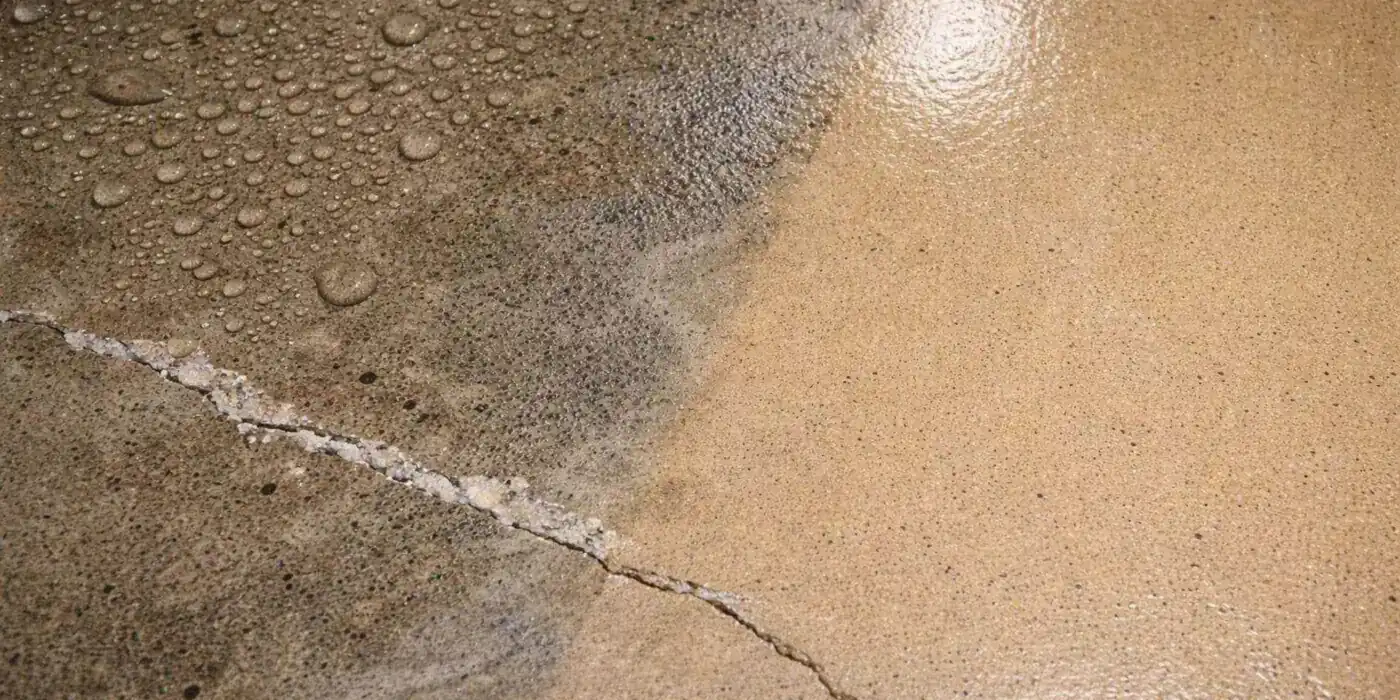
A coating isn’t armor, though. If a slab is already scaling, it has to be ground and repaired before it is coated. And the strip just inside the door gets the worst of it, which is why we wrote a separate guide on why floors peel at the garage door.
Planning a Floor Before Next Winter?
Call for a free on-site estimate. We check the slab, talk through the right system for your garage or basement, and give you a written price.
The Slab Underneath: Old Houses, Basements and Karst
A floor coating is only as strong as the concrete it is attached to. St. Louis has one of the oldest housing stocks of any big American city — the median home in the City of St. Louis was built in 1938 — and inner-ring suburbs such as University City, Webster Groves and Kirkwood are largely post-war. Old slabs can be perfectly sound, but they have had decades to collect oil, paint, sealers and cracks, and none of that can stay under a new coating.
Moisture is the other big one. Basements and older slabs are more likely to carry moisture up from the ground, and a coating sealed over a damp slab can blister or lift from below. We check the slab for moisture before coating. The region’s history — the record 1993 Mississippi flood and the December 2015 Meramec flood that closed I-44 and I-55 — is a reminder that water finds its way into basements here. A coating will not waterproof a basement, but a sound, coated floor is far easier to clean up after water gets in.
Much of St. Louis County also sits on karst: limestone with caves and sinkholes beneath it. That is background, not a reason for alarm, but it is one reason we look at cracks carefully. If a crack is still moving, we will tell you before we coat. A floor coating won’t stop a slab from moving.
What Actually Shortens a Floor’s Life
- Skipped prep. A coating rolled onto a smooth, dusty or oily slab has little to hold on to. Diamond-grind slab prep opens the surface so the coating can bond.
- Moisture nobody checked. It shows up later as blisters or lifting from below.
- A top coat that doesn’t fit the job. Bare epoxy in a sunny garage ambers; a soft coating in a hot garage picks up tires.
- Thin, one-coat kits. Retail kits can look good for a season, but they go on thin and are usually rolled over a slab that was only washed.
- No care at all. Dragged metal, dropped tools and solvents left sitting will mark any floor. Rinsing and prompt repairs make a real difference.
Care Through the St. Louis Year
- Winter: squeegee slush out the door after storms, and rinse the floor when dried brine leaves a white film.
- Spring: give the floor a full wash with a pH-neutral cleaner to clear the last of the salt and grit.
- Summer: not much to do; wipe up oil and fluids before they sit.
- Any time: put plastic or felt pads under jack stands and heavy cabinets, and get a chip repaired before water gets under its edge.
There is more detail in our guide to cleaning and maintaining an epoxy floor, and typical prices are in the St. Louis cost guide.
Frequently Asked Questions
How long does an epoxy floor last in St. Louis?
As general product guidance, a professionally installed residential floor lasts roughly 10 to 20 years and a commercial floor roughly 5 to 15 years. Where a floor lands in that range depends mostly on slab preparation, moisture, the top coat and how the floor is cared for.
How durable is epoxy flooring in a St. Louis garage?
Durable, when it is part of a full system. Epoxy bonds well and builds thickness; topped with a UV-stable polyaspartic or polyurethane coat, it handles summer sun, hot tires and winter slush. A thin, single-coat kit is far less durable.
Does road salt damage an epoxy floor?
A sound, sealed coating keeps salt and brine on the surface, where you can rinse them off. Problems start when a coating is chipped or poorly adhered and brine works under the edge, usually near the garage door. Rinsing the floor through the winter helps.
Is summer or winter harder on a garage floor here?
Both matter. St. Louis averages about 47 days a year at 90°F or more, which brings hot tires and sun, and about 85 freezing nights, which bring meltwater and brine. A good system is chosen with both in mind.
Can a coating fix a cracked or moving slab?
No. Cracks are filled and repaired before coating, but a coating cannot stop a slab that is still moving. If we see signs of movement, we tell you before any work starts.
Will a coating stop moisture in my basement?
No. A floor coating does not waterproof a basement. We check the slab for moisture before coating, and a water problem needs to be fixed at its source first.