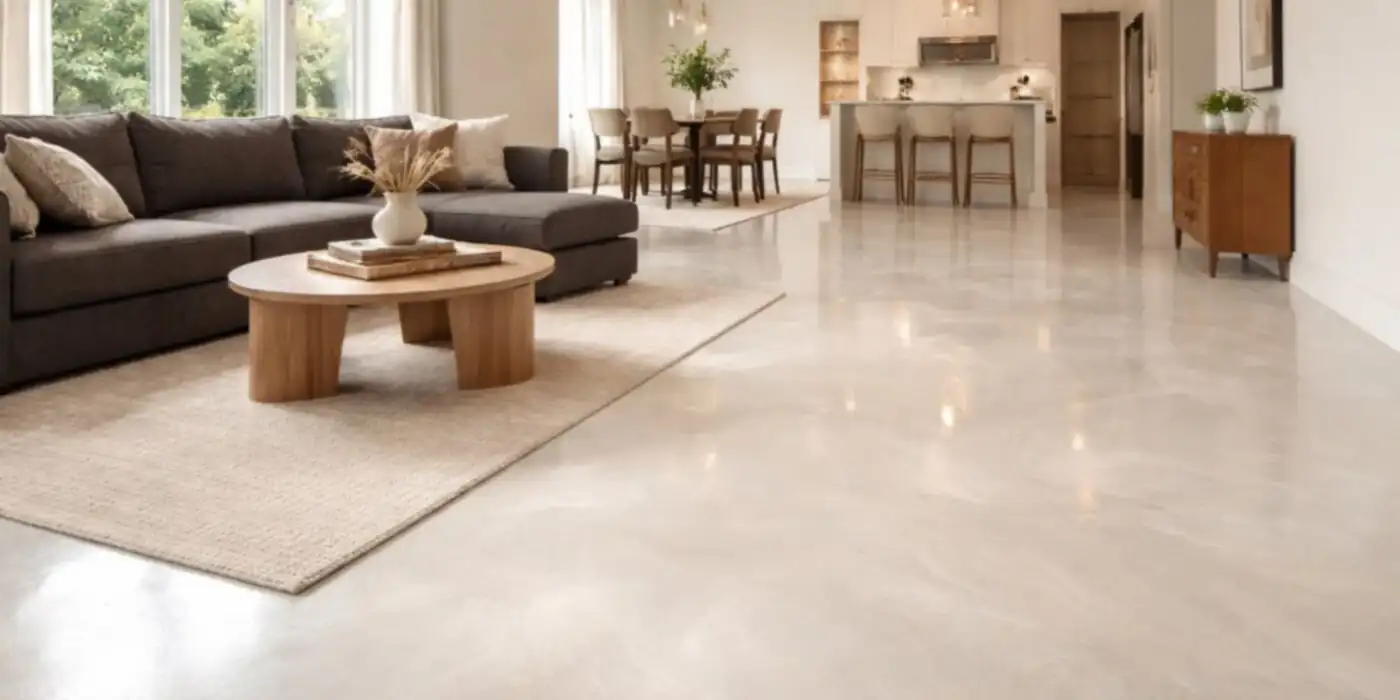
Epoxy is a chemical coating, and we won't dress it up as anything else. What we can say honestly is this: low-VOC options are available for St. Louis homes, and coating a sound slab you already own usually uses far less material than breaking it out and pouring a new one. We don't claim environmental certifications for our floors. We do give straight answers about odor, ventilation and what happens to the old concrete.
Whether you live in a pre-war brick house in the city, a post-war ranch in Webster Groves or a 1990s two-story in Wildwood, the question is the same: can the floor you have be saved, and finished with something you're comfortable breathing around while it cures? Most of the time the answer is yes. Here's how we think it through. To talk about your own floor, call (314) 334-1902.
The Honest Answer on “Green” Epoxy
Floor-coating marketing is full of words like “eco,” “non-toxic” and “zero-emission.” Some of those claims rest on product data and some don't, and the details change from one product to the next. So here's where we stand:
- What we will say: low-VOC options are available, we'll tell you which products are going down on your floor, and we'll plan ventilation with you before work starts.
- What we won't say: that a floor coating is certified green, that it improves your indoor air, or that it stops moisture coming up through the slab. Those claims need testing we haven't done.
That leaves two environmental points that are real: the air in your home during and after the job, and the material you avoid sending to a landfill.
Low-VOC Options We Offer
VOCs — volatile organic compounds — are the solvents that evaporate out of many paints and coatings as they cure. They're most of what you smell. Solvent-heavy products release more of them; high-solids and low-VOC products release less. Solid-color floors can be done in a 100%-solids epoxy, where the resin and hardener react into the coating instead of relying on a solvent that has to evaporate away.
Top coats are where most of the choice sits. Polyaspartic and polyurethane top coats come in a range of formulations, and low-VOC versions are available. If someone in the house is sensitive to odors, if the basement shares air with the rest of the home, or if you simply want the gentlest route, say so at the estimate and we'll quote the low-VOC option. Some of those products behave a little differently — working time, cure time or sheen — and we'll explain any trade-off before you decide.
Ventilation is the other half. In a garage, the overhead door goes up and fans run. In a basement, we plan airflow before anything is mixed and suggest keeping family and pets on another floor while the coating cures. Light foot traffic is usually fine within about 24 hours, and most residential projects are completed in one day; some take two.
Keeping the Slab You Already Have
The biggest material saving in any floor project is the slab you don't replace. Tearing out a garage or basement floor means jackhammers, a dumpster of broken concrete and a fresh pour. Coating it means grinding off a thin skin of the surface, filling cracks and adding a few coats measured in thousandths of an inch. When the slab is sound, finishing it is the lower-waste path nearly every time.
“Sound” is the key word. A coating is not a structural repair. Much of St. Louis County sits on karst — limestone with caves and sinkholes beneath it — and some slabs crack because the ground under them shifted. If a crack is still moving, we'll tell you before we coat. We won't hide settlement under a floor coating; that kind of problem goes to a structural engineer first.
Keep the Slab, Lose the Stains
Ask about low-VOC options at your free on-site estimate anywhere in St. Louis and St. Louis County.
Old Slabs Across St. Louis: City, Inner Ring, West County
St. Louis has an unusually old housing stock, which makes “save the slab” a practical question instead of a slogan. Census figures show three generations of concrete:
- The city. The median home in St. Louis city was built in 1938, and more than half its homes predate 1940. Many garages sit behind the house on the alley, built where 19th-century alley houses once stood. Those slabs have absorbed decades of oil, salt and patching.
- The inner-ring suburbs. Median build years run from 1949 in University City and 1952 in Webster Groves to 1955 in Ladue and 1962 in Kirkwood. Garage and basement slabs there are typically well over 60 years old.
- West County. Chesterfield's median home dates to 1982 and Wildwood's to 1992. Their slabs are younger and often have never been coated, so the job is usually protection rather than rescue.
For the two older groups, grinding, crack repair and a coating can turn a stained, pitted floor into a usable room without a single truckload of new concrete. For newer homes, sealing a slab early keeps salt and oil out of it from the start.
Basements: Air, Moisture and Clean-Up
Basements are where people think hardest about air quality, and rightly so: it's an enclosed space, often tied into the furnace and air-conditioning returns. That's where a low-VOC product and a ventilation plan matter most.
Basements are also where water turns up. St. Louis has a long history with high water — the Mississippi's record crest in 1993, the Meramec's December 2015 flood — which is one reason we check basement slabs for moisture before we coat them. An epoxy floor does not waterproof a basement and won't stop water or sewer backups. What it does give you is a sealed surface you can mop out and disinfect, instead of carpet or bare concrete that holds on to the mess. If the moisture readings say a floor isn't ready, we'll tell you.
Old Floor Tile and Black Adhesive
Many older basements were finished decades ago with 9-inch or 12-inch vinyl floor tile laid in black adhesive. Some of those tiles and adhesives contain asbestos. Intact tile is generally left alone, but it should never be ground or sanded without testing. If we find old tile or black adhesive on your slab, we'll stop and recommend a lab test; if it comes back positive, an asbestos abatement contractor deals with it before we start. Grinding first and asking later isn't something we do.
Less Waste on the Job
- Measure, then mix. We measure the floor at the estimate and mix in batches sized to the area, so less leftover resin ends up hardening in a bucket.
- Catch the dust. Diamond grinding is paired with vacuum dust collection, which keeps concrete dust out of your house and yard.
- Repair instead of replace. Cracks, spalls and pitted patches are filled and ground flat rather than cut out.
- Recoat instead of redo. When a coated floor wears, a properly prepped fresh top coat can often renew it without stripping the whole system.
- Straight advice. If your existing floor only needs a clean or a small repair, we'll say so.
Frequently Asked Questions
Is epoxy flooring environmentally friendly?
It's a chemical coating, so we don't call it green. The environmental case is narrower and real: coating a sound slab avoids demolishing and re-pouring concrete, and low-VOC options are available for the coats that go down in your home.
Do you offer low-VOC epoxy in St. Louis?
Yes. Low-VOC options are available, and you can ask for them at the free estimate. We'll tell you which products we'd use, how they differ from the standard system, and how we'll ventilate the space while the floor cures.
Is the smell a problem during installation?
Any coating gives off some odor while it cures, which is why we plan ventilation before we start. Garages get the door open and fans running; basements get an airflow plan, and we suggest keeping people and pets away until the floor has cured. Light foot traffic is usually fine within about 24 hours.
Can an old St. Louis slab be coated instead of replaced?
Usually, if the slab is sound. Many city and inner-ring homes have slabs well over 60 years old that only need grinding, crack repair and a coating. If a crack is still moving, we'll tell you before we coat and recommend a structural check first.
Does an epoxy floor stop basement water?
No. A coating doesn't waterproof a basement or stop backups. It gives you a sealed surface that's easy to mop out and disinfect. We check the slab for moisture before coating and will tell you if the floor isn't ready.
What if my basement has old floor tile?
Old vinyl tile and black adhesive can contain asbestos, so we never grind them without testing. If we find them, we recommend a lab test, and if it's positive, an asbestos abatement contractor handles the material before we begin.
Talk to Us About Your Floor
We work across St. Louis and St. Louis County — Kirkwood, Webster Groves and University City through Chesterfield, Ballwin and Wildwood. Call (314) 334-1902 or request a free on-site estimate, and ask about low-VOC options when we visit. For how our weather treats a coated floor, read how St. Louis's climate affects epoxy floor durability; for the spot where coatings usually fail first, see why epoxy floors peel at the garage door.
Related Articles
How St. Louis's Climate Affects Epoxy Floor Durability
About 85 freezing nights, brine on the highways and muggy summers: what that means for a coated floor.
Why St. Louis Epoxy Floors Peel at the Garage Door
Why the strip inside the overhead door is usually the first place a garage coating gives out.