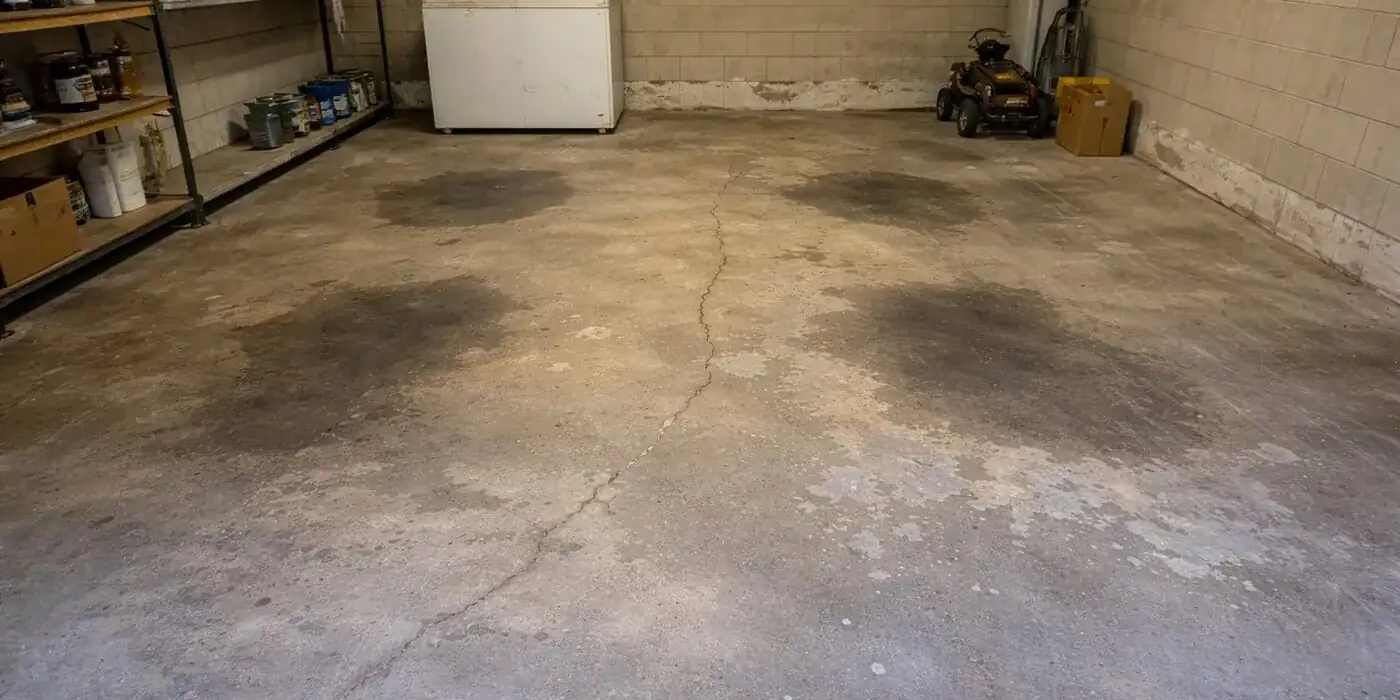
If you have seen a garage floor coating fail, you have probably seen it fail in the same place: a ragged, lifting band in the first foot or two inside the door, while the rest of the floor still looks fine. It is the most common complaint people bring us about floors that someone else put down, and it is almost always preventable.
Why the Strip Inside the Door Fails First
That strip has the hardest life of any part of the floor:
- It is outdoor concrete in disguise. The model residential building code requires a garage floor to slope toward a drain or the main vehicle door, so water runs to the threshold and sits there. The same code groups garage slabs with porches and steps as weather-exposed concrete, and St. Louis County cities such as Florissant rate local weathering as “severe.”
- It gets the slush first. Brine and snowmelt drip off the car the moment it pulls in.
- It swings in temperature. With the door going up and down, that edge feels the outside air — July heat and January freezes — more than anywhere else in the garage.
- It takes every tire. Each car turning in rolls over it, hot in summer and wet in winter.
Put a coating with any weakness there and that is where it shows first. These are the usual weak points.
Cause 1: The Concrete Was Never Properly Prepared
A coating holds on by gripping the surface of the concrete. A slab that is smooth, dusty, sealed or soaked with oil gives it very little to grip. Plenty of failed floors were coated after a wash and not much else, or with a retail kit that relies on a quick surface treatment.
Our standard is diamond-grind slab prep: grinding the floor with diamond tooling to take off the weak top layer, old sealers and contamination, and to leave an open, textured surface. Cracks and spalls are filled and repaired. At the door we pay particular attention to the edge, where the concrete is often weakest and dirtiest.
Cause 2: Moisture Coming Up Through the Slab
Concrete can carry moisture up from the ground. When a coating is sealed over a damp slab, pressure builds underneath and pushes it off, often starting at an edge. Older slabs, and slabs where water pools near the door, are more likely to have this problem, though newer ones can too.
That is why we check the slab for moisture before coating. If it is damp, there are primers made for that situation. If there is an active water problem, it has to be fixed first. Coating over it only moves the failure date.
Cause 3: The Wrong Top Coat for a St. Louis Garage
Epoxy is an excellent base coat: it bonds well and builds thickness. As the only coat on a garage floor, it has weak spots. It tends to amber in sunlight, and a thin or soft film can let go under hot tires. St. Louis averages about 47 days a year at 90°F or hotter, and a car coming off Highway 40 on one of those afternoons brings very hot tires straight onto the threshold.
For garages we usually finish with a polyaspartic top coat. It cures fast, stays UV-stable, and resists hot-tire pickup and automotive fluids better than bare epoxy. Polyurethane top coats are another option on some floors. Anti-slip additives are available for every coating we install — worth having right where wet shoes and slush come in. The trade-offs are laid out in epoxy vs. polyaspartic.
Cause 4: Brine and Meltwater Working Under an Edge
MoDOT pre-treats area highways with salt brine mixed with beet juice, and the City of St. Louis adds a liquid magnesium/calcium chloride to its road salt. Concrete engineers note that deicing chemicals make surface scaling worse and that magnesium-based salts are hard on concrete. On a well-adhered floor, the coating keeps all of that on top. Once there is a chip, an unsealed edge or a weak spot, salty water gets underneath.
St. Louis averages about 85 freezing nights a year, and most of them thaw by afternoon, so that water freezes and thaws again and again, prying the edge loose a little more each time. That is why threshold failures so often appear after the first or second winter: the weak spot was there from day one, and winter found it.
Floor Lifting at the Door?
Call for a free on-site look. We will tell you whether it needs a repair or a full recoat before you commit to anything.
Four Questions to Ask Any Installer
- “How will you prepare the slab?” Listen for grinding and crack repair, not just cleaning.
- “Will you check the slab for moisture first?” The answer should be yes, along with what happens if it is damp.
- “What goes on top, and why that for a garage?” You want a top coat chosen for sun, hot tires and slush.
- “What do you do at the door edge?” A good answer covers the edge detail, not just the middle of the floor.
For what a full system typically costs here, see the St. Louis epoxy cost guide.
How We Build the Threshold
- Inspect the slab and the door edge, including any old coating, scaling or cracks.
- Check the slab for moisture.
- Diamond-grind the floor, with extra attention to the first few feet inside the door.
- Repair cracks, spalls and scaled spots so the edge is solid.
- Apply the base coat and, if you chose one, the decorative flake.
- Finish with a UV-stable polyaspartic top coat, with an anti-slip additive if you want one.
Most residential projects are completed in one day; some take two. Light foot traffic is usually fine after about 24 hours, and we will tell you when the floor is ready for the car.
Already Peeling? What a Repair Involves
A peeling threshold can usually be fixed, but patching over loose coating doesn’t hold. The failed coating has to come off back to where it is still firmly attached, the concrete underneath is ground and repaired, and the area is recoated so the new edge blends into the old floor. If the failure is widespread or there is a moisture problem, it is often better to remove the old coating entirely and start over. We will tell you which applies once we have seen it. Our repair and recoat service has more detail.
Frequently Asked Questions
Why does my garage floor coating peel at the door?
The strip inside the door takes the most water, brine, temperature swings and hot tires. Any weakness in the prep, a moisture problem or the wrong top coat shows up there first, and meltwater freezing under a loose edge makes it spread.
How soon do poorly installed floors fail?
It varies, but threshold peeling often appears within the first year or two, frequently after the first winter, when brine and freezing meltwater find a weak spot that was there from installation.
What top coat holds up best at the threshold?
For most St. Louis garages we recommend a polyaspartic top coat over the base coat. It cures fast, is UV-stable and resists hot tires and fluids better than bare epoxy. Anti-slip additives can be added.
Does road salt cause the peeling?
Salt and brine rarely cause it on their own. They take advantage of a weak bond, a chip or an unsealed edge. On a well-prepared, well-adhered floor they stay on the surface and can be rinsed off.
Can a peeling threshold be repaired?
Usually. The loose coating is removed back to sound material, the concrete is ground and repaired, and the area is recoated. If the failure is widespread or moisture is involved, a full removal and recoat may be the better choice.
How do I keep the threshold in good shape?
Squeegee slush out after storms, rinse dried brine off through the winter, and get chips repaired before water gets under them.