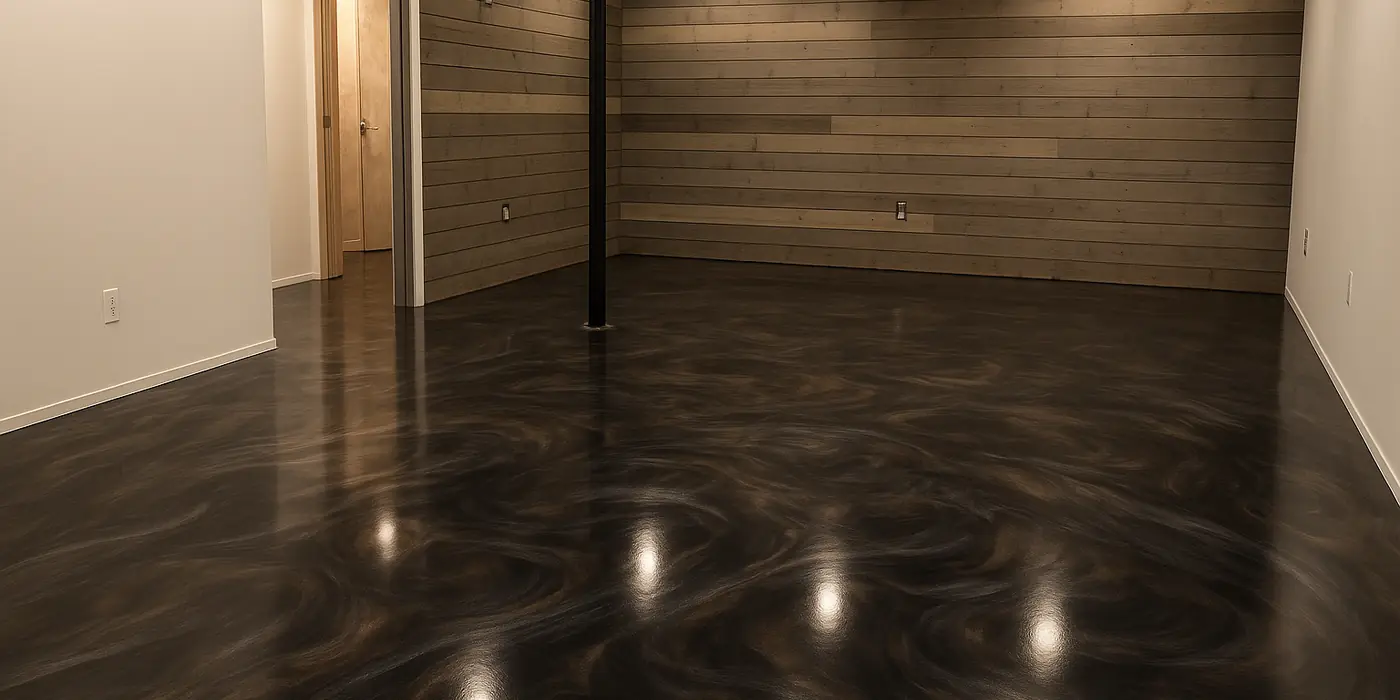
A metallic epoxy floor looks poured rather than painted: swirls, depth and movement that shift as light moves across the room. In St. Louis we see it most in finished basements, and in stores and showrooms that want the floor to be part of the design. It's the most artistic finish we install, and the one that rewards the most planning. Here's how it's made, where it works, how it compares with flake and solid color, and what to think about before you choose it.
What a Metallic Floor Is
A metallic floor starts the way every floor we install starts: the slab is diamond-ground to open the surface, cracks are filled, and the concrete is checked for moisture. Next comes a base color, then a clear epoxy carrying metallic pigment. While that layer is still wet, the installer works it — rolling, brushing and steering the pigment — to create veining and movement. A clear top coat seals everything in.
No two floors come out alike. Because the pattern is made by hand in a wet coating, you choose the colors and the overall style — soft and cloudy, bold and marbled, a lava-style flow — rather than an exact pattern. That's part of the appeal, and it's worth knowing going in.
Why Metallic Suits St. Louis Basements
Half of new homes built in the Midwest still get a basement, and older St. Louis houses have them too. The floor is usually what makes a basement feel unfinished, and metallic changes the feel of the room more than any other coating. One of our customers put it this way:
“My basement epoxy floor looks amazing now. The metallic finish really changes the whole vibe. Crew was efficient and polite.”
— Reilly M., Google review
Basements bring two practical considerations. The first is moisture: we check the slab before coating, because water vapor coming through concrete can lift any coating. If a basement takes on water, that has to be solved first — a coating doesn't waterproof a basement. The second is humidity: July dew points here average in the upper 60s, and a cool basement floor can collect condensation on muggy days. A dehumidifier helps, and we can add anti-slip texture to the top coat so a glossy floor keeps its grip.
Basement floors typically run about $6–$9 per square foot in the St. Louis area (typical, not a quote). Metallic is a decorative upgrade, so we price it after seeing the room and talking through the look you want.
Showrooms, Stores and Living Spaces
Metallic does its best work where people actually look at the floor: a retail store, a showroom, a salon, a home bar or a family room. It reflects light, so smaller rooms feel bigger and display areas look deliberate. One retail customer's review describes Vince and his team getting the store floor finished before the grand opening — timing is often the hardest part of a commercial job, and we plan around it.
In a business, metallic usually goes in the customer-facing part of the space, while the back of house gets a tougher, more textured system. Our commercial flooring guide explains how we split those.
Metallic, Flake or Solid Color?
Most decorative floors we install use one of three looks. Here's how they compare.
| Feature | Metallic | Flake | Solid color |
|---|---|---|---|
| Look | Marbled, flowing, deep | Speckled, granite-like | One even color |
| Hides slab flaws | Somewhat | Very well | Least |
| Grip when wet | Needs anti-slip additive | Texture from the flakes | Needs anti-slip additive |
| Best rooms | Basements, showrooms, living spaces | Garages, shops, basements | Utility rooms, storage, workshops |
| Typical price | Quoted per room | About $5–$9 per sq ft with a polyaspartic top coat | Quoted after the estimate |
| Pattern | Hand-made, one of a kind | Even broadcast | Uniform |
If you're torn, start with how the room is used. A daily-use garage is flake territory. A basement you'll spend evenings in, or a space you want people to notice, is where metallic earns its premium.
Pick your size, finish, and color. Get your St. Louis price range in 60 seconds.
Open Floor Studio →Metallic in a Garage: Worth Knowing
Metallic can go in a garage, and with good lighting it's striking. A few things to weigh first. A smooth metallic surface shows dust and tire marks more than flake does, and it needs an anti-slip additive to handle snowmelt. Salt season matters as well: MoDOT's brine and the City's road salt end up on the floor all winter, so plan on rinsing the area inside the door about once a week. And on hot summer days tires come off the highway hot, so the right top coat is part of the plan. Plenty of homeowners put flake in the garage and save metallic for the basement.
Choosing Colors and Sheen
Metallic colors are built from a base tone plus one or more metallic pigments. Some combinations people ask us about:
- Grays and silvers for a cool, stone-and-concrete look.
- Coppers, bronzes and warm browns that pair well with the brick of the city's older neighborhoods and with wood trim.
- Deep blues and charcoals for a home bar or media room.
- Pearl and white blends for a bright showroom.
Sheen matters as much as color. A high-gloss top coat shows the most depth; a satin finish hides dust and footprints better. Ask Vince to walk you through colors and sheen at the estimate, or try combinations first in our Floor Studio.
Planning and Price
- Size and shape of the room. Open rooms go faster than ones with lots of corners, posts and doorways.
- Slab condition. Cracks, old coatings, adhesive and moisture all add prep.
- Design complexity. More colors and more hand work take more time.
- Top coat and grip. We'll recommend the clear coat and texture that fit how the room is used.
Most residential projects are completed in one day; some take two. Light foot traffic is usually fine within about 24 hours. For typical St. Louis prices across floor types, see our cost guide.
Thinking About a Metallic Floor?
Bring your color ideas to a free on-site estimate. We'll check the slab, walk you through colors and quote the room.
Frequently Asked Questions
Is metallic epoxy good for a basement?
Yes, it's one of the most popular uses. We check the slab for moisture first, because vapor coming through the concrete can lift any coating, and we add anti-slip texture to the top coat if the floor may get damp. A coating doesn't waterproof a basement, so any water problems should be fixed first.
How much does a metallic epoxy floor cost in St. Louis?
Basement floors typically run about $6–$9 per square foot in the St. Louis area. Metallic is a decorative upgrade that depends on the room and the design, so we price it after a free on-site estimate.
Is metallic epoxy slippery?
A smooth, glossy metallic floor can be slick when wet. We offer anti-slip additives for all of our coatings and recommend them for basements, garages and any area that may see water.
Can I choose the exact pattern?
You choose the colors and the general style, from soft and cloudy to bold and marbled. The pattern itself is made by hand while the coating is wet, so every floor is one of a kind.
Should I put metallic or flake in my garage?
Flake is usually the better fit for a daily-use garage: it hides dust and tire marks and has built-in texture. Metallic can work with good lighting and an anti-slip additive, but many homeowners choose flake for the garage and metallic for the basement.
Do you install metallic floors in stores and showrooms?
Yes. Metallic suits customer-facing spaces such as showrooms and retail floors. We plan commercial installs around your opening date or business hours and quote each project after a site visit.
Related Articles
How Much Does Epoxy Flooring Cost in St. Louis? (2026 Price Guide)
Typical St. Louis prices for garage and basement floors, labelled as typical, not a quote.
Epoxy vs. Polyaspartic Flooring in St. Louis: Which Is Right for You?
How the two coatings differ on cure time, UV stability and hot-tire resistance.
Commercial Epoxy Flooring in St. Louis: Warehouses, Retail and Restaurants
Which coating fits a warehouse, store, kitchen or service bay, and how we schedule around your business.