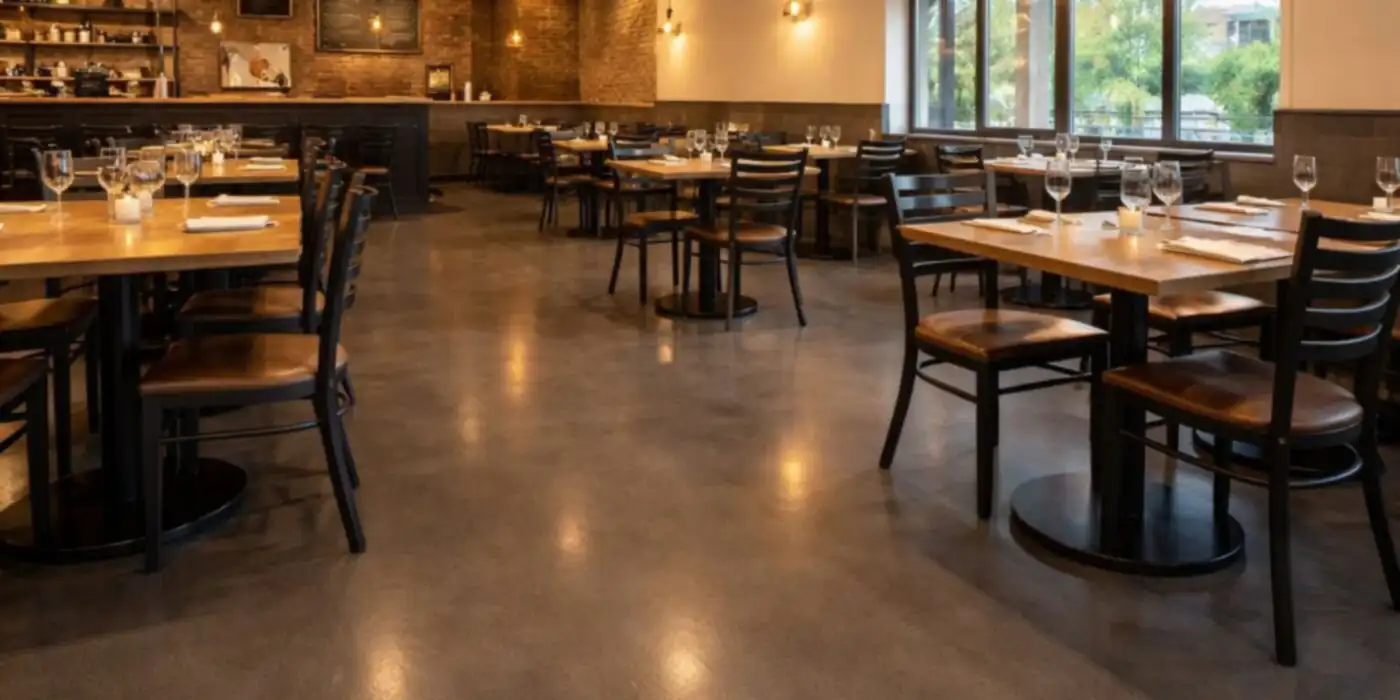
A good commercial floor earns its money quietly. It takes pallet jacks, shopping carts, grease and salty boots without turning into a line item on next year's repair budget. Ascent Epoxy St. Louis coats concrete for warehouses, retail stores, restaurants, shops and service bays across the city and St. Louis County. Every commercial job is quoted per project after a site visit, because a small kitchen and a big distribution floor have almost nothing in common except the concrete underneath.
Below: which coating fits which kind of business, what our weather does to commercial concrete, how we keep you open while the work happens, and what goes into a quote. If you would rather just talk it through, call (314) 334-1902.
Who Calls Us for Commercial Floors
The St. Louis economy is bigger than its famous names. Aerospace plants in north county, the hospital campuses and the brewing tradition that put Soulard on the map all keep a deep bench of smaller businesses busy: suppliers, machine shops, flex warehouses off I-270 and I-44, dealerships, gyms, clinics, restaurants and taprooms. Those smaller operations are the people we work for. National flooring firms handle the mega-sites, and we won't pretend otherwise.
Our Google reviews reflect that mix. A retail owner's review describes Vince and his team finishing the store floor before the grand opening. Two others, in their own words:
“If you're looking for a reliable and professional epoxy flooring installation service, this is the company to call. They did a fantastic job on our industrial warehouse floors, and the epoxy coating has made them much easier to clean and maintain.”
— Jacquelin D., Google review
“Called them for my shop floor—super clean job, no mess, and durable finish. Would use again.”
— Katrina M., Google review
Warehouses and Industrial Floors
Bare warehouse concrete sheds dust, drinks up spills and wears a groove wherever forklifts turn. A thick epoxy build, or a flake floor sealed under a polyaspartic or polyurethane top coat, gives the slab a hard wear layer that sweeps clean and bounces light around a dim building. Aisles, dock zones and pedestrian lanes can be laid out in contrasting colors inside the coating itself, so the lines don't scuff away the way floor paint does.
Prep matters more in a warehouse than anywhere else. Old sealers, curing compounds, rubber marks and years of oil all have to come off first, so we diamond-grind the slab to open it up, fill cracks and joints, and check the concrete for moisture before anything is mixed. For heavier manufacturing floors, see our industrial epoxy flooring page.
Retail Stores and Showrooms
In a store, the floor is part of the merchandising. Shoppers register a stained, patched slab even if they never say so. A metallic finish gives a showroom a deep, poured-stone look; a flake floor in a tight color blend reads clean and modern and hides scuffs; a solid color keeps attention on the product. All three handle cart wheels, fixture moves and steady foot traffic, and all three wipe down at closing time.
For most retailers the bigger question is timing. A new store has an opening date and a build-out that tends to run late; an existing store can't give up a weekend of sales. We plan the coating around that calendar — more on scheduling below.
Restaurants, Kitchens and Taprooms
A commercial kitchen floor lives with hot water, grease, food acids and mopping several times a day. That's the job urethane cement was made for: it copes with wet, hot areas far better than a standard epoxy, and it can be carried a few inches up the wall as a cove base so there's no seam at the floor line for grime to settle into. Taprooms and small breweries get the same treatment in the brewing and wash-down areas, with something more decorative out front where guests walk.
Where floors are wet, grip isn't optional. We offer anti-slip additives for all of our coatings, and a kitchen gets more texture than you'd want in a dining room. If your health inspector has particular expectations for floors and cove bases, share them before we quote and we'll write the spec around them.
Auto Shops, Service Bays and Dealerships
Service bays collect motor oil, brake fluid, antifreeze and dropped wrenches, and they take tires that just came off a hot highway. Lambert averages about 47 days a year at 90°F or hotter; on afternoons like that, a weak coating can soften under a hot tire and lift. A chemical-resistant base under a tough top coat stands up to fluids and hot tires and cleans with a mop instead of a can of degreaser. Next door, the showroom usually wants something that looks finished, and one building can easily carry two different systems.
Matching the Coating to the Work
This is where the conversation usually starts. The final spec comes after we've seen the slab and how the space is used.
| Space | What the floor deals with | Where we usually start | Finish options |
|---|---|---|---|
| Warehouse / storage | Forklifts, pallet jacks, dust | High-build epoxy with a polyaspartic or polyurethane top coat | Solid color, marked aisles and zones |
| Retail / showroom | Foot traffic, carts, appearance | Flake or metallic epoxy under a clear top coat | Metallic, flake blends, solid color |
| Restaurant kitchen / brewery | Hot water, grease, constant wet cleaning | Urethane cement with a cove base | Textured, anti-slip |
| Auto shop / service bay | Oil, fluids, hot tires, dropped tools | Epoxy base with a polyaspartic or polyurea top coat | Flake or solid color |
| Office, clinic, gym | Rolling chairs, frequent cleaning, appearance | Epoxy or polyaspartic system | Solid color or flake |
Pick your size, finish, and color. Get your St. Louis price range in 60 seconds.
Open Floor Studio →What St. Louis Weather Does to a Commercial Floor
Brine and salt at the doors
MoDOT pre-treats St. Louis-area highways with salt brine mixed with beet juice, and the City's Street Division adds a liquid magnesium/calcium chloride to its salt so it keeps working in the cold. Every delivery driver, customer and employee carries a little of it inside. Entries and dock aprons are where commercial floors wear first, so that's where the toughest top coat goes, and where we suggest walk-off mats and a squeegee for the season.
Hot, humid summers
July dew points here average in the upper 60s and climb into the mid-70s on muggy days. Humidity matters during installation: a coating shouldn't go down on a slab cool enough to collect condensation. We compare slab temperature with the air before we coat and move the schedule if the numbers aren't right. It's one of the less glamorous reasons to hire an installer rather than a painting crew.
Freezing nights, light snow
Lambert logs about 85 nights a year at or below freezing but only around 16.6 inches of snow. Concrete near overhead doors and loading docks swings between frozen and thawed again and again while slush rides in all winter. A coated floor keeps that water and salt on top, where it can be squeegeed out, instead of letting it soak into bare concrete.
Scheduling Around Your Business
The coating is rarely the expensive part of a new commercial floor; the closed days are. So we plan around your hours:
- Phased work. Large floors can be split into zones, so part of the building keeps running while another section is ground, coated and cured.
- Around your calendar. Small kitchens, storefronts and offices can often be done on your slowest days. Tell us your window and we'll tell you honestly whether the system you need fits inside it.
- Fast-cure top coats. Polyaspartic cures quickly, which shortens the time a floor is off limits. Light foot traffic is usually fine within about 24 hours; vehicles and heavy equipment take longer, and we'll give you the timing for your system.
- Fixtures and stock. We agree in advance who moves what, so nobody shows up to a room full of shelving.
Planning a Commercial Floor in St. Louis?
Tell us about the space and your schedule. Vince or one of his crew measures and quotes in person after a free site visit.
How We Quote a Commercial Floor
Commercial and industrial floors are quoted per project after a site visit. We don't publish a per-square-foot figure for commercial work, because the gap between a light-duty office coating and a urethane-cement kitchen is too wide for one number to mean anything. What moves the price:
- Square footage and layout. Open warehouse floors go faster per foot than small rooms full of drains, columns and cove bases.
- Slab condition. Old sealers, oil, cracks, failed coatings and moisture all add prep time.
- The system. High-build epoxy, polyaspartic, polyurea and urethane cement are different materials at different costs.
- Your schedule. Phased work, one section at a time, takes more planning than an empty building.
The estimate is free and on site. Vince or one of his crew measures and quotes in person, after asking how the space is used. For homeowner pricing, our St. Louis epoxy flooring cost guide lists typical residential ranges, and our commercial epoxy flooring page covers the service in more detail.
Frequently Asked Questions
How much does commercial epoxy flooring cost in St. Louis?
We quote every commercial and industrial floor per project after a free site visit. Square footage, the condition of the slab, the coating system and whether the work has to be phased all move the number, so a single per-square-foot figure would mislead more than it would help.
Can you coat our floor without shutting us down?
Usually, yes. Larger floors can be phased so part of the building stays in use, and smaller spaces can be booked for your slowest days. Fast-cure polyaspartic top coats shorten the time a floor is off limits; light foot traffic is usually fine within about 24 hours.
What is the best floor coating for a restaurant kitchen?
For hot, wet kitchens we usually recommend urethane cement. It handles hot water and constant wet cleaning better than a standard epoxy and can be run up the wall as a cove base. We add texture with anti-slip additives so the floor keeps its grip when it's wet.
Is a commercial epoxy floor slippery?
A smooth, glossy coating can be slick when wet. We offer anti-slip additives for all of our coatings and adjust the amount of texture to the space, so a kitchen or entry gets more grip than an office.
Which coating works best for a warehouse?
Most warehouse floors start with a high-build epoxy finished with a polyaspartic or polyurethane top coat. It handles forklifts and pallet jacks, sweeps clean and lets us mark aisles and dock zones inside the coating. We confirm the spec after checking the slab.
Do you coat auto shops and service bays?
Yes. Service bays need resistance to oil, brake fluid and antifreeze, plus a top coat that holds up to hot tires in a St. Louis summer. We pair a chemical-resistant base with a tough top coat, in flake or solid colors.
Related Articles
How Much Does Epoxy Flooring Cost in St. Louis? (2026 Price Guide)
Typical St. Louis homeowner prices for garage and basement floors, and what pushes a quote up or down.
How St. Louis's Climate Affects Epoxy Floor Durability
Brine, freezing nights and muggy summers: how St. Louis weather shows up on a coated floor.